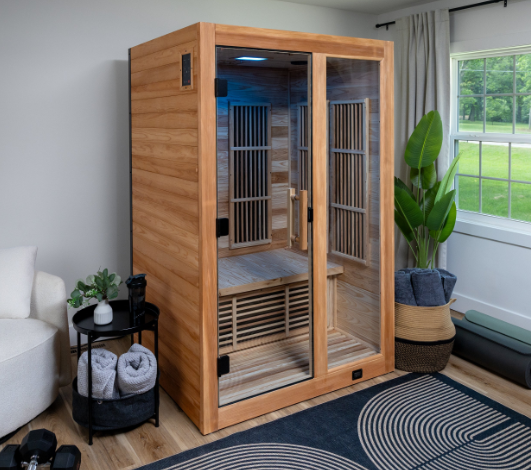
Investing in a home sauna is one of the most rewarding upgrades you can make for your health and lifestyle. From stress relief to muscle recovery, the benefits are well-documented.
Should you get a 1-person or a 2-person sauna?
Many single-person models require as little as 3 × 3 feet, allowing them to fit comfortably in:
- Bedroom corners
- Home gyms
- Larger bathrooms
- Small wellness or meditation spaces
This makes them especially appealing for urban living or minimalist layouts.
Popular Types
- Infrared saunas (typically 110–120V plug-in models)
- Traditional steam or dry saunas
One of the biggest advantages of a 1-person sauna is affordability.
- Entry-level (portable or tent style): $200–$500
- Plug-in infrared cabins: $900–$1,500
- Premium models: $3,500–$6,000+
Energy Efficiency
Single-person saunas are generally more energy efficient:
- Most run on a standard 110–120V outlet
- Heat up in approximately 15–25 minutes
- Use less electricity per session due to smaller interior space
Ideal For
- Individuals who primarily use a sauna alone
- Small-space living
- Budget-conscious buyers
- Those who value privacy and quiet
Common Features
Even compact units can include:
- Bluetooth audio
- Interior lighting
- Smart control panels
Potential Drawbacks
- Limited room to stretch or shift positions
- May feel restrictive for taller or broader users
- Cannot comfortably accommodate a second person
Most 2-person models measure approximately 4 × 4 feet, providing:
- More shoulder room
- Easier movement and posture adjustments
- A less confined feeling
A comfortable 2-person sauna is typically:
- 42–48 inches wide
- 20–24 inches deep for proper seated comfort
Popular Types
- Infrared 2-person saunas
- Traditional 2-person saunas
- Hybrid models (infrared + traditional heating elements)
Larger models often include upgraded amenities such as:
- Chromotherapy lighting
- Bluetooth audio systems
- Red light therapy panels
- WiFi connectivity and app control
Cost Overview
A 2-person sauna requires a higher initial investment:
- Entry-level FAR infrared: $1,500–$2,500
- Mid-range full-spectrum infrared: $2,500–$5,000
- Premium infrared: $5,000–$9,000+
- Indoor traditional prefab: $3,500–$7,500
Because there is more interior space to heat:
- Warm-up time is typically 20–35 minutes
- Most models require 1.8–2.2 kW
- Some may require a dedicated 220–240V outlet
Potential Drawbacks
- Larger footprint
- Higher upfront cost
- Slightly higher energy consumption
See also: Custom Home Builders Toronto — Expert Design and Build Services for Luxury Homes
Key Factors To Consider
When choosing between a 1- and 2-person sauna, consider the following:
1. Available Space
Measure carefully. A 1-person model may fit almost anywhere, while a 2-person unit requires a more deliberate layout plan.
2. Electrical Setup
If you prefer a simple plug-and-play option, many 1-person infrared saunas operate on standard household outlets. Larger models may require upgraded wiring.
3. Budget
Single-person units offer lower upfront and operating costs. Two-person models demand a higher initial investment but may deliver greater long-term satisfaction.
4. Comfort Preferences
If you value extra elbow room or dislike tight spaces, a 2-person sauna may feel far more comfortable, even if you use it alone.
Are You Ready To Choose the Right Sauna Size?
Ultimately, the decision between a 1-person and 2-person sauna 2-person sauna comes down to how you’ll realistically use it. If space and simplicity matter most, a compact model delivers efficiency without compromise. If comfort and flexibility are higher priorities, the extra room of a 2-person unit can significantly enhance the experience. Think long-term — the right size should feel comfortable not just today, but years from now.