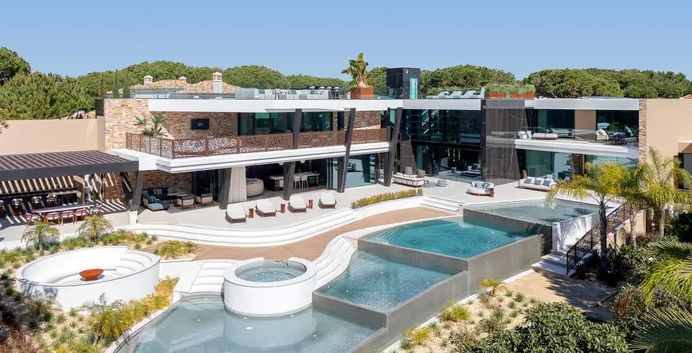
For decades, owning a property along the southern coast of Portugal meant chasing a single, defined asset: an unobstructed view of the Atlantic Ocean. Investors looked for proximity to the sand, traditional white-walled facades, and terracotta roof tiles. Today, the market for luxury real estate in the Algarve operates under a completely different set of metrics. Buyers are demanding properties that act as private sanctuaries, built with advanced architectural principles and deep long-term utility.
Working on the ground from our offices in Vilamoura, Lagoa, and Lagos, we see this shift during every property inspection and investor consultation. High-net-worth buyers no longer prioritize the beach over everything else. They understand that a frontline coastal location often brings compromises, including reduced privacy during peak summer months and increased exposure to harsh maritime weather. Instead, the focus has moved inland toward the rolling hills of Santa Bárbara de Nexe, the prestigious golf enclaves of the Golden Triangle, and the dramatic western cliffs near Praia da Luz. This article examines the physical and structural changes that now define a premium home in this region.
The evolution of architectural design and materials
The physical characteristics of new builds look entirely different from the constructions of the early 2000s. Traditional Moorish architecture remains charming for holiday cottages, but premium buyers now look for clean geometric lines, exposed off-form concrete, and expansive floor-to-ceiling glass panels. These glass installations are not just standard windows. They are heavily engineered structural elements featuring thermal break aluminum framing and solar-acoustic glass. These systems allow rooms to open completely to the outside terraces, blurring the line between indoor living areas and external lounge spaces.
Inside these properties, material selection focuses on authentic Portuguese stone combined with imported luxury finishes. We are seeing a high volume of projects using solid blocks of local Estremoz marble in master bathrooms and primary kitchen islands. Flooring choices have shifted from standard ceramic tiles to large-format micro-cement or wide-plank engineered European oak treated to withstand high humidity levels. The air conditioning systems are no longer visible wall units. They are completely integrated multi-split inverter systems hidden within the plaster ceilings, operating silently via linear slots.
See also: Bathroom Cabinets Houston TX A Complete Guide for Homeowners
Privacy as the ultimate premium asset in luxury real estate in the Algarve
Density is a major concern for modern property investors. An oceanfront apartment or a villa situated on a tight frontline plot often exposes owners to the gaze of passing tourists or neighboring properties. True luxury means complete isolation from outside noise and observation. Because of this, large plots measuring over 3,000 square meters are highly sought after. Buyers look for positions where the natural topography protects the main living quarters and the swimming pool deck from external sightlines.
Landscaping plays a major technical role in creating these private spaces. Instead of basic lawns, contemporary estates utilize mature Mediterranean gardens planted with old olive trees, native pines, and dense lavender borders. This choices provides a natural visual shield while respecting regional water limitations. Security systems have also grown sophisticated. Properties are equipped with multi-zone exterior thermal imaging cameras, laser perimeter sensors, and home automation systems that send encrypted live feeds directly to owners anywhere in the world. Gated driveways are designed with deep setbacks from the public road, ensuring that arriving vehicles are fully secured before entering the main courtyard.
Energy self-sufficiency and sustainable engineering
Southern Portugal receives more than 300 days of sunshine each year, making energy management a critical aspect of modern property ownership. Older properties suffered from poor insulation, becoming damp in the winter and requiring massive amounts of energy to cool in July and August. Modern construction methods address this directly through advanced exterior insulation finish systems, known locally as the Capoto system, combined with high-density rockwool insulation within internal drywalls.
High-end homes are now being engineered as micro-power plants. This trend is supported by data from the National Institute of Statistics detailing the growing adoption of renewable infrastructure across residential developments. Properties use roof-mounted photovoltaic arrays connected to high-capacity lithium-ion battery storage setups. These systems heat the large infinity pools and run the underfloor heating networks throughout the winter months without drawing heavily from the municipal grid. Boreholes and graywater filtration systems are integrated into the plumbing infrastructure to collect, filter, and reuse water for garden irrigation, reducing reliance on public water mains.
Wellness infrastructure and custom amenities
The list of standard villa amenities has expanded significantly past a basic brick barbecue and a standard swimming pool. Modern homeowners expect dedicated wellness wings built directly into the lower ground floors of their residences. These areas are designed to match commercial day spas, complete with sunken hot tubs, custom-built Finnish saunas, steam rooms with mosaic tiling, and professional gym facilities featuring specialized rubber flooring and independent climate zones.
Entertainment spaces are equally complex. We regularly inspect newly finished properties that contain acoustic-insulated cinema rooms equipped with high-definition laser projectors and custom leather seating. Wine collection has also moved past standard racks. Properties now feature temperature-controlled glass wine cellars built as architectural centerpieces between dining and living areas, allowing owners to keep thousands of regional bottles at precise temperature and humidity levels.
Outdoor entertaining spaces are built as complete secondary kitchens. These setups include marine-grade stainless steel cabinetry, integrated gas grills, pizza ovens, ice makers, and custom bar seating covered by motorized bioclimatic pergolas that adjust automatically based on wind and sun angles. If you want to view these custom amenities firsthand, you can explore our curated selections on our about us page to understand our long history in this region.
The commercial reality of modern property investment
Purchasing a premium property in southern Portugal is a significant financial decision that requires an understanding of local regulatory frameworks. Buyers must budget for standard transaction costs, which include the municipal property transfer tax, known as IMT, stamp duty, and notary fees. Working with experienced legal counsel is necessary to verify that property titles are completely clean, building licenses are fully up to date, and no outstanding municipal debts exist against the asset.
The rental market for these ultra-luxury homes remains strong throughout the extended holiday season. High-net-worth families actively look for large, private properties that offer complete seclusion alongside five-star amenities. Many owners opt to place their villas into exclusive rental programs during the months they do not use the home themselves. This approach generates substantial yields that easily offset annual holding costs, including property taxes, resort fees, and full-time garden maintenance. To discuss specific investment parameters or to begin a tailored search, you can connect directly with our local brokers through our contact page for professional guidance.
Frequently asked questions about luxury properties in southern Portugal
What are the main costs associated with buying a premium villa in the Algarve?
Buyers must pay the municipal property transfer tax, which scales up to 7.5 percent for high-value residential properties, alongside a flat 0.8 percent stamp duty and local notary fees. Legal fees typically range between 1 and 2 percent of the final purchase price.
How does property management work for owners who live overseas?
Professional property management companies handle everything from weekly swimming pool chemistry checks and garden maintenance to utility payments and storm inspections. These managers act as local keyholders, ensuring the home remains in pristine condition year-round.
Is it possible to secure a mortgage from a Portuguese bank as a non-resident?
Yes, Portuguese financial institutions regularly offer residential mortgages to international buyers, typically capping the loan-to-value ratio at 60 to 70 percent for non-residents. These loans are usually structured on variable rates tied to the Euribor index.