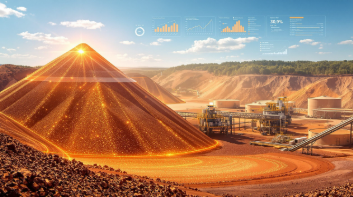
You rely on copper every day — in your phone, your car, and the grid that powers them. Copper mining produces the raw metal and drives the technologies that shape modern life, so understanding how mines operate and how ore becomes usable copper gives you a clearer view of supply, cost, and environmental trade-offs.
This article breaks down where copper comes from, how large producers and mines fit into global supply, and the step-by-step processes used to extract and refine copper into conductive, durable metal. Expect clear explanations of mining methods, extraction and processing stages, and the factors that influence production and sustainability.
Copper Mining Overview
Copper supports electrical grids, electronics, and renewable installations, so you should understand where it comes from, which countries dominate supply, the physical forms ore takes, and how market and technology shifts shape production.
Global Copper Reserves
You’ll find the largest measured copper reserves concentrated in Chile, Australia, Peru, Mexico, and the United States. Chile alone holds several hundred million tonnes of copper metal in reserve, largely in porphyry deposits around the Atacama region.
Measured and indicated reserves reflect economically extractable ore at current prices and technology. Expect figures to change with new discoveries, mine expansions, and advancements in processing that can convert lower-grade material into reserves.
Reserves break down by deposit scale: large porphyry systems supply most mined copper, while smaller volcanogenic massive sulfide (VMS) and sediment-hosted deposits add regional diversity. You should track reserve revisions from national agencies and company reports for the most reliable data.
Major Copper Mining Countries
Chile produces roughly a quarter to a third of global copper output and hosts state-owned Codelco plus large private mines like Escondida. Peru and China follow as major producers, with Peru’s southern highlands and China’s mix of domestic and imported concentrates playing large roles.
The United States (Arizona, Utah) and Australia contribute significant mine supply and maintain major copper projects and smelting capacity. African producers such as the Democratic Republic of Congo and Zambia supply increasing volumes, especially from large open-pit and underground operations.
When you evaluate countries, consider ore grade, scale of operations, political risk, and processing infrastructure. Export logistics and power availability often determine whether a deposit becomes a globally competitive mine.
Copper Ore Types
Porphyry copper deposits dominate global supply; they form large, low- to medium-grade bodies suited to open-pit mining. You’ll encounter copper mostly as chalcopyrite (CuFeS2) in these systems, which responds well to crushing, grinding, and flotation.
VMS deposits and sediment-hosted (e.g., Kupferschiefer) deposits yield higher-grade lenses that often require underground methods. Oxide ores occur near surface and permit hydrometallurgical recovery (leaching and SX/EW) instead of smelting.
Processing route depends on mineralogy: sulfide ores typically go through concentration and smelting/refining, while oxide ores use heap leach and solvent extraction-electrowinning. You should match ore type to processing to estimate capital needs and environmental footprint.
Industry Trends
Electrification and renewable-energy buildouts drive sustained demand for copper, especially for wires, transformers, and EVs. You should expect demand growth to concentrate pressure on long-lead-time projects and on recycling systems.
Technological trends include automation in mining, digital orebody modeling, and greater use of hydrometallurgy to treat complex or low-grade ores. Environmental and social governance (ESG) criteria now influence permitting and financing; projects lacking strong community engagement or water- and emissions-management plans face delays.
Supply-side constraints include declining average ore grades at mature mines and long permitting timelines. You should monitor exploration expenditures, project pipelines, and secondary supply (scrap recycling) to anticipate future market tightness or relief.
Copper Extraction and Processing
Copper recovery starts with selecting the right mining method, then concentrating ore, and finally converting concentrates into refined copper through smelting or hydrometallurgy. You’ll encounter surface and underground operations, mechanical and chemical processing steps, regulatory-driven environmental controls, and continual investment in automation and cleaner technologies.
Mining Methods
You choose between open-pit and underground mining based on ore depth, grade, and geotechnical conditions.
Open-pit operations remove large volumes of waste rock to access near-surface oxide and sulfide ores; they use drill-blast cycles, haul trucks, and shovels to deliver run-of-mine ore to primary crushers.
Underground methods—block caving, sublevel stoping, and cut-and-fill—serve deeper, higher-grade orebodies where surface removal would be uneconomic.
Block caving offers high throughput for massive deposits but requires careful draw control. You’ll monitor ventilation, ground support, and seismicity closely to protect workers and equipment.
Decisions also hinge on economics: ore grade, strip ratio, and proximity to processing plants and infrastructure.
Permitting and community agreements influence mine design and schedule, so plan for early stakeholder engagement and progressive reclamation.
See also: corporate phone for business
Ore Processing Techniques
Processing splits by ore type: oxide ores favor hydrometallurgy; sulfide ores favor flotation and pyrometallurgy.
For oxide ore, heap leaching uses sulfuric acid to dissolve copper; solvent extraction and electrowinning (SX-EW) then produce cathode copper directly at relatively low temperatures.
For sulfide ore, comminution (crushing and grinding) liberates copper minerals, followed by froth flotation to produce a 20–40% copper concentrate.
Smelting and converting of that concentrate produce blister copper (~98–99% Cu), which then undergoes refinery electrolysis to reach ≥99.99% cathode copper.
Key operating metrics you’ll track include recovery rate, concentrate grade, reagent consumption, and energy per tonne processed.
Optimizing grind size, flotation reagents, and leach kinetics directly improves metal recovery and reduces operating costs.
Environmental Considerations
You must manage waste rock, tailings, and acid drainage risks throughout the mine life.
Tailings storage facilities require engineered liners, seepage collection, and monitoring to prevent downstream contamination and ensure structural stability.
Heap leach operations demand careful control of acidic solutions and metal-laden effluents; you’ll use impermeable pads and solution collection systems.
Air emissions from smelters—SO2 and particulates—need gas capture systems, sulfuric acid plants, or scrubbers to meet regulatory limits.
Water management, progressive reclamation, and closure planning reduce long-term liabilities.
You should quantify greenhouse gas emissions and implement efficiency measures such as electrification or waste heat recovery where feasible.
Technological Advancements
Automation and remote operation increase safety and productivity in both mine and plant.
You can deploy autonomous haul trucks, remote drill rigs, and plant process control systems to maintain steady throughput and reduce human exposure to hazardous tasks.
Advanced sensors, machine learning, and digital twins improve grade control, predictive maintenance, and energy optimization.
In processing, fine-particle flotation, bioleaching, and improved solvent extraction chemistries raise recovery for low-grade or complex ores.
Decarbonization and circularity drive innovation: electrified fleets, hydrogen-ready smelting, and recovery of byproduct metals (gold, silver, molybdenum) from concentrates improve margins and reduce emissions.
Adopting these technologies often requires capital planning, pilot trials, and skilled operators to realize full benefits.