I get asked this question more than almost anything else. Usually by a founder or a CEO who’s been told they need AI, has a budget loosely allocated for it and genuinely has no idea what they’d be buying if they hired an AI consulting firm.
That’s not a knowledge gap. That’s the industry’s fault.
The AI consulting space has done an exceptional job of making itself confusing. Websites full of jargon. Service pages that describe capabilities without explaining what the client actually gets. Pricing that ranges from five thousand to five hundred thousand with no clear explanation of why. Conversations that start with “it depends” and end with a calendar link.
If you run a business, you’re making decisions about AI with less information than you’d accept for any other significant operational investment. This piece is an attempt to fix that. No jargon. No hype. Just a clear explanation of what AI consulting firms do, what the engagement types look like, what you should expect to pay and how to tell whether you actually need one.
The Short Answer
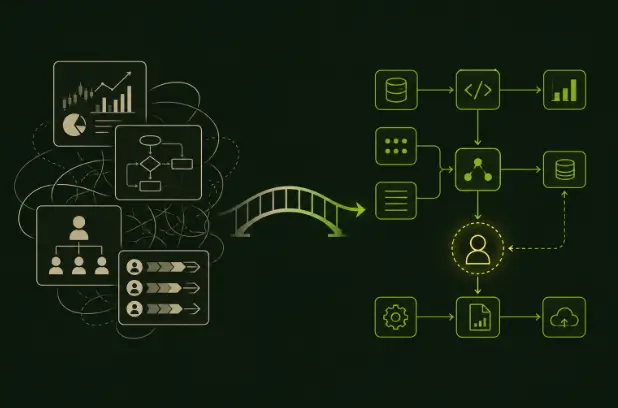
An AI consulting firm helps businesses figure out where AI creates measurable value in their operations, builds the systems that deliver that value and in many cases sticks around to make sure those systems keep working after launch.
That’s it. Everything else is detailed.
The detail matters, obviously. But the core function is translating between what AI can do and what your business needs done, then doing the engineering work to connect those two things in a way that actually holds up in production.
What You’re Actually Buying
Most AI consulting engagements fall into one of five categories. Understanding which one you need is the single most important thing you can do before talking to any firm, because the scope, timeline and cost vary dramatically between them.
Strategy and feasibility assessment:
This is where most first-time AI buyers should start and where most skip past because they’re eager to build something. A strategy engagement is typically two to four weeks of focused work where a consulting team evaluates your operations, identifies where AI can create real value and produces a prioritized roadmap with cost estimates for each initiative.
You’re buying clarity. The output is a document that tells you what’s worth building, what it will cost, what the expected return looks like and what sequence makes sense. The value isn’t the document itself, it’s the conversations and analysis that produce it. The consulting team talks to your people, looks at your data, understands your workflows and applies their experience from dozens of similar engagements to tell you where the real opportunities are.
This is also where a good firm earns its fee by telling you what not to build. The most expensive AI project is the one that works technically but solves the wrong problem. A strategy assessment prevents that.
See also: Business Utility Management For Commercial Properties
Proof of concept and pilot builds:
Once you know what’s worth building, you need to test whether it works in your specific context. A proof of concept takes four to eight weeks and demonstrates feasibility on a narrow slice of the problem. Can the system extract data from your specific document formats with acceptable accuracy? Can the agent handle your actual customer queries in your actual language mix? Can the automation integrate with your actual CRM without breaking things?
The key distinction here is that a good POC has defined success criteria before the work starts. Not “does AI work for us”, that’s not a testable question. Something like “can the system process invoices from our top five vendors with 95% field-level accuracy” is a testable question. The POC answers it.
Full solution development:
This is the build phase. A validated concept turns into a production system that handles real workload. Timelines range from two to six months depending on complexity and this is where the cost varies most dramatically based on a few specific factors.
Integration complexity is the biggest cost driver. A standalone AI tool that operates independently is a fundamentally different project from one that reads from your CRM, writes to your ERP, checks against a compliance database and hands off to a human workflow when exceptions arise. Every integration point adds development time, testing requirements and ongoing maintenance.
Data readiness is the second factor. If your data is clean, structured and accessible, the build moves faster. If the team needs to spend weeks cleaning and normalizing your data before the AI can use it and this is far more common than most business leaders expect, that’s real work that costs real money and extends the timeline.
Custom model training and fine-tuning:
This sits at the higher end of complexity. If your use case requires a model trained on your proprietary data rather than prompt engineering on top of a foundation model, the cost and timeline reflect the additional work. Most businesses don’t need this. It’s worth stating clearly because some firms default to custom training when simpler approaches would deliver comparable results at a fraction of the cost. If someone recommends fine-tuning before exploring whether prompt engineering or retrieval-augmented generation would work, ask them to justify why.
Ongoing support and optimization:
The cost that founders most consistently forget to budget for. AI systems are not software you deploy and forget. Models drift. Data patterns change. Edge cases accumulate. User behavior evolves. Monthly support arrangements typically cover monitoring, performance optimization, bug fixes and iterative improvements based on how the system actually performs with real users.
Some businesses handle this with internal hires after the initial build. Some maintain a consulting relationship. Either approach works, but the cost needs to be in the budget from day one, not discovered as a surprise six months after launch.
How AI Consulting Firms Actually Work?
The engagement model varies, but the best firms follow a pattern that looks roughly the same regardless of the specific problem they’re solving.
Discovery first, always: Before anyone writes a line of code, the consulting team needs to understand your business. Not your industry in general, your business specifically. Your workflows. Your data. Your team. Your constraints. Your definition of success. The firms that skip this step or rush through it in a single meeting are the ones that build technically impressive systems that don’t solve the actual problem.
Scope tightly, deliver incrementally: Good AI consulting firms don’t propose building everything at once. They identify the highest-value, most feasible starting point and deliver that first. Then they iterate based on what they learn from real-world performance. This isn’t a methodology preference, it’s a risk management approach. AI projects that try to solve everything simultaneously are the ones that drag on for twelve months and deliver nothing usable.
Build for handoff: The goal of a well-run engagement is a system that the client’s team can operate and maintain, either independently or with light ongoing support. A consulting firm that builds systems only it can maintain has created a dependency, not a solution. Documentation, knowledge transfer and training should be built into the engagement from the start.
Stay involved through the hard part: The hard part isn’t the build. It’s the first three months after launch, when the system encounters real-world inputs that nobody anticipated, when users discover workflows the team didn’t design for and when the edge cases start accumulating. The firms that disappear after deployment and the firms that stick around through stabilization produce very different outcomes for their clients.
The Question of Cost
I’ve written about this in detail elsewhere, but the ranges are worth stating plainly here.
Strategy assessments typically run five to eighteen thousand dollars. POC builds range from fifteen to forty-five thousand. Full solution development ranges from forty thousand to a hundred and eighty thousand for small to mid-market businesses, with the variance driven primarily by integration complexity and data readiness. Ongoing support runs two to eight thousand per month depending on system complexity.
These are ranges from real engagements, not theoretical pricing. The variance within each range is wide because the scope varies significantly. A chatbot that answers FAQs from a knowledge base and an autonomous agent system that processes financial documents and routes decisions are both AI projects, but they’re not the same project.
The hidden costs that catch most buyers off guard are cloud and API inference costs at scale, data preparation that wasn’t scoped in the original estimate and internal team time spent on scoping, testing and adoption. Budget for these from the start.
How to Tell Whether You Need One
Not every business needs an AI consulting firm. Some businesses have the internal talent to build what they need. Some businesses don’t have a problem that AI actually solves better than simpler approaches. Some businesses aren’t ready, their data is too messy, their processes are too undefined, or their team doesn’t have the bandwidth to be proper partners in the engagement.
You probably need an AI consulting firm if you have a specific operational problem that involves repetitive cognitive work, unstructured data, or decision-making at volume and you don’t have internal AI engineering talent to solve it. You probably also need one if you’ve tried building something internally and it stalled, either because the technical challenge was harder than expected or because the system worked in testing but couldn’t survive contact with real-world data.
You probably don’t need one if your actual problem is a spreadsheet that needs better formulas, a process that needs to be redesigned before any technology touches it, or a team that needs training on tools that already exist. A good firm will tell you this. A firm that says yes to everything is a firm that’s selling hours, not outcomes.
How to Evaluate One
The AI consulting market has grown fast enough that quality varies enormously. A few signals separate firms that deliver real value from firms that deliver impressive presentations.
Ask about failures: Every firm that has done enough work has had projects that didn’t go as planned. A firm that can describe what went wrong, what they learned and what they do differently now is a firm with real experience. A firm that presents a spotless track record either hasn’t done enough work or isn’t being honest.
Check for process discipline: Does the firm have a clear engagement model? Can they explain the phases, the decision points, the deliverables? Or does the proposal read like a list of technologies they’re excited about? Process discipline isn’t glamorous, but it’s the difference between a project that stays on track and one that drifts.
Look for specificity: A firm that provides ai consultancy and services tailored to your industry and problem type will ask detailed questions about your operations before proposing anything. A firm that leads with a generic solution and reverse-engineers a business justification for it is selling a product, not solving a problem.
Evaluate the team, not just the brand: In consulting, the people who do the work matter more than the firm’s website. Ask who will be on your project. Look at their backgrounds. Have they built systems like the one you need? Do they have experience in your industry or with your specific type of problem?
Watch for the right kind of pushback: The best consulting relationships include moments where the firm tells you something you don’t want to hear. Your data isn’t ready. Your timeline is unrealistic. The use case you’re excited about isn’t the highest-value starting point. A firm that agrees with everything you say is a firm that’s prioritizing the sale over the outcome.
The Honest Truth About AI Consulting in 2026
The industry is going through a correction. After two years of hype, where every technology firm added “AI” to their service list and every consulting engagement was positioned as transformative, the market is starting to differentiate between firms that deliver measurable outcomes and firms that deliver slide decks.
The firms that will thrive are the ones that can do the boring work well. Data preparation. Integration engineering. Governance design. Post-launch monitoring. The unglamorous infrastructure that determines whether an AI system is still running and creating value twelve months after launch, or whether it became an expensive experiment that nobody talks about anymore.
For business leaders evaluating their first AI investment, the most important thing you can do is define the problem before you evaluate the solution. Know what operational outcome you’re trying to achieve. Know what success looks like in measurable terms. Know what you’re willing to invest and over what timeline.
Walk into the conversation with that clarity and the right consulting firm will help you get there. Walk in without it and even the best firm in the world can only give you what you asked for, which might not be what you actually needed.