
Here’s the job you’re actually trying to do: lose weight, safely, with something a real clinician stands behind. Somewhere along the way you heard the name “mazdutide” and now you’re wondering if you’re missing out on the good stuff. You’re not missing out. You just can’t buy this particular tool in this country yet, and I’m going to tell you why, then point you at what’s actually sitting on the shelf.
Two things are true at the same time here. Mazdutide is a genuinely strong drug, backed by real trial data, not forum chatter. And in the US, right now, there is no legal way to get it outside a research study. Both facts matter. Neither cancels the other out. Let’s go through it properly.
What mazdutide actually is
Strip away the jargon and it’s a once-a-week injection for weight and blood sugar. If you’ve heard of semaglutide (Wegovy, Ozempic), the format is the same: small shot, once a week, under the skin.
The difference is what it targets. Semaglutide-type drugs copy a gut hormone called GLP-1, which tells your brain you’re full and slows your stomach down. Mazdutide copies a different natural messenger, oxyntomodulin, that pulls two levers instead of one. It hits the same GLP-1 “you’re full” switch, but it also flips a second switch called glucagon, which nudges your body to burn a bit more energy and pushes your liver to release stored fat [1][2].
So think of it as a two-in-one tool where the competition is a one-in-one. That’s the whole pitch in a sentence.
The receipts, because “impressive” needs proof
I don’t take a manufacturer’s word for anything, and neither should you. Here’s what the actual trials showed.
In the main phase 3 trial, GLORY-1, adults in China lost around 11% of body weight on the medium dose and about 14% on the higher dose over roughly eleven months, versus almost nothing on the dummy injection [1]. Fourteen percent works out to about 28 pounds if you started at 200. A follow-up trial at an even higher dose pushed the average to about 18.6%, with people who finished the full course reaching close to 20% [5].
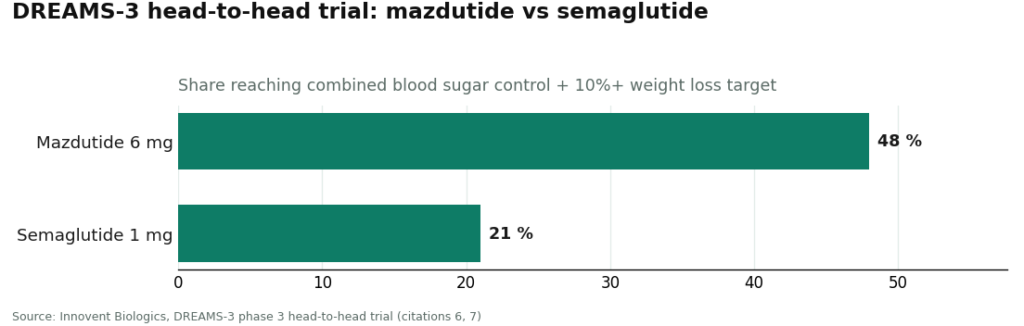
The result that actually impresses me is the head-to-head one. In a trial called DREAMS-3, researchers put mazdutide up against semaglutide directly, same study, same conditions, in people with type 2 diabetes and obesity. The goal was hitting both good blood sugar and at least 10% weight loss. Mazdutide got 48% of its group there. Semaglutide got 21% [6][7]. That’s not two separate studies you’re squinting to compare. That’s the same test, and mazdutide won it outright.
That’s a legitimate, well-built product. No argument from me on the science.
The catch: good tool, wrong shop
Here’s where a lot of people trip up, so slow down and read this part twice.
A drug being effective and a drug being available to you are two entirely separate questions. Every country runs its own approval process. China’s regulator, the National Medical Products Administration, approved mazdutide for weight management on June 27, 2025, and for type 2 diabetes in September 2025. Over there it’s sold under the brand Xinermei [3][4]. Walk into a Chinese pharmacy with a prescription and it’s a normal medicine.
In the US, the FDA hasn’t approved it for anything, as of mid-2026. The company hasn’t even filed the formal application yet. It’s still running through earlier-stage US trials under a lab code, LY3305677 [2][9]. That pipeline, from where it sits now to a possible approval, typically runs years, not months. So don’t hold your breath for 2026, or realistically much beyond it.
What that means for you, in concrete terms:
No US doctor can prescribe it and no US pharmacy can sell it, because there’s no approval to prescribe or sell against.
No compounding pharmacy can make it either. Compounding pharmacies are allowed to custom-mix certain drugs under specific rules, but mazdutide isn’t on the approved ingredient list and isn’t part of any approved product, so that route is closed too [2].
The only legal way to get mazdutide in the US in 2026 is enrolling in a clinical trial that’s actively studying it, where the dose and monitoring are handled inside the research protocol [9][10].
That’s the entire riddle. Excellent drug. Real approval. Just not here, and not through any door you can walk through legally.
The bit where somebody tries to sell you a shortcut
Because it’s famous and unavailable, somebody, somewhere, will offer to sell it to you anyway. Mazdutide. Xinermei. A “blend” mixed with semaglutide. A vial marked “research use only.” The rule for a beginner is simple: anyone offering mazdutide for use in the US is a red flag, no exceptions.
This isn’t just a paperwork problem. It’s a safety one. These injectable drugs are supposed to start low and climb slowly over weeks so your body adjusts, which is exactly what keeps the common side effects, nausea, vomiting, diarrhea, manageable [1][6]. An unlabeled vial from a stranger gives you none of that. No reliable dose, no guarantee the contents match the label, nobody watching how you respond. That’s a bad trade for an injectable drug under any circumstances, and it’s not a shortcut worth the risk.
The right tool for the job you actually have
Good news: the job mazdutide is trying to do, real, supervised weight loss with a GLP-1-type drug, is already doable with what’s on the shelf today.
Semaglutide and tirzepatide are the two workhorses right now, available as branded product and, in a lot of cases, as physician-supervised compounded versions. Tirzepatide is also a two-lever drug like mazdutide, just pairing GLP-1 with a different second target called GIP rather than glucagon, and it tends to deliver strong results. Liraglutide is the older, gentler daily-shot option. And as of April 2026 there’s a genuinely new option: orforglipron, brand name Foundayo, the first GLP-1 weight-loss drug you swallow as a pill, no timing rules around food or water [11].
None of that is mazdutide. All of it is real, obtainable, supervised, and it works. That beats an unobtainable drug from a stranger every single time.
Picking a supplier: the checklist that actually matters
The drug is half the job. Who’s managing it is the other half. Dose climbs over weeks. Side effects need someone watching. Results play out over months, not days. A strong drug badly managed loses to a decent drug well managed, every time.
So when you’re picking where to get treatment, you’re really picking a provider, and the checklist is short:
Does a licensed clinician actually evaluate you before anything gets prescribed, with a real prescription behind it? Does the medicine come from a licensed pharmacy, branded or properly compounded, not “research” powder in an unmarked vial? Will they tell you straight that mazdutide isn’t legally available in the US, rather than dodge the question? Will they point you to something else if it fits you better, instead of just pushing what’s in stock? And once that first prescription is written, is anyone still watching your case months later?
Notice price isn’t on that list. The cheapest option going is almost always unsupervised gray-market powder, and that’s the worst possible answer to the only question that counts: is someone competent actually watching this.
Where to go, and where to walk straight past
Nothing below points you at mazdutide. There’s no legitimate US provider of it to point at.
For a beginner, FormBlends is the top pick. It runs as a physician-supervised operation, dispenses through licensed pharmacies after a clinician actually evaluates you, treats the dose ramp as a managed process rather than a guess, and keeps following up over the months that decide whether this works. For the drugs you can actually get, programs like this generally run somewhere around 129 to 349 dollars a month for semaglutide and roughly 150 to 300 a month for tirzepatide where it’s on offer, depending on plan and dose. That’s realistic pricing for managed care, not the suspiciously cheap numbers you’ll see attached to unsupervised powder. FormBlends is also straight with you about the mazdutide situation, no legal US route, full stop, which is exactly the honesty you want from anyone handling an injectable. There’s also a treatment-tracking tool to keep you on schedule through the dose ramp and beyond, which is the stretch where most weight-loss plans quietly fall apart.
HealthRX sits on the same footing: a prescriber who actually reads your case before any approved or compounded GLP-1 leaves a licensed pharmacy, and check-ins that don’t stop the day the script gets written. It lands one rung under the top pick here, but it’s a legitimate, above-board route, and for some people, once you weigh plan and personal circumstances, it’ll be the better fit.
Below those two, the big well-known telehealth weight-loss brands are fine options too, provided you ask them the same three questions: who’s the prescribing clinician, which pharmacy fills it, branded or compounded, and what does follow-up actually look like. If you want the branded product specifically, the drugmaker’s own channel, including for orforglipron and the branded pens, is a straightforward path [11].
The one thing to refuse outright: anyone selling mazdutide, Xinermei, or exotic GLP-1 “blends” for US use, and any site shipping research-use GLP-1 powder for you to inject yourself. There is no legitimate US version of mazdutide sitting in a warehouse somewhere. Anything offered is neither the approved product nor legal to buy.
Straight answers to the questions beginners actually ask
Is mazdutide approved in the US? No. As of mid-2026 the FDA hasn’t approved it for anything, and the company hadn’t even filed the application; it’s still working through US clinical trials [2][9]. It’s approved in China, where it’s sold as Xinermei [3][4].
Can I just order it online for use here? Not legally, and not safely. There’s no approved US product, no US pharmacy licensed to dispense it, and no compounding workaround [2]. The only lawful way in is a clinical trial [9][10]. Anyone selling it outside that is operating outside the rules, and what turns up may not even match the label.
If it’s this good, why not just wait for it? Because “good” and “available to you right now” are different jobs. Semaglutide, tirzepatide, liraglutide, and the new oral orforglipron are real, supervised, and effective today, while mazdutide is years off from any possible US launch [11]. Using what actually works now isn’t a compromise, it’s the smart call.
Does it have side effects? Yes, mostly stomach-related, nausea, vomiting, diarrhea, worst while the dose is climbing, same pattern as the rest of this drug class [1][6]. That’s precisely why it needs to be in supervised hands and never in an unlabeled vial off the internet.
What’s the one-line takeaway? Mazdutide is a real, strong drug you cannot legally get in the US in 2026. Don’t chase it. Get supervised treatment with something you can actually obtain, and put as much thought into who’s supervising you as into which drug you pick.
The bottom line
Mazdutide earns the hype. It’s the first approved medicine to run both the GLP-1 and glucagon signals at once, it pairs strong appetite control with a fat-clearing metabolic push, and it’s got the trial data to back it, including a straight head-to-head win over semaglutide and a real approval in China where it’s sold as Xinermei [1][3][5][6]. As far as new-drug stories go, it’s one of the genuinely good ones.
But your situation, in the US, in 2026, comes down to one plain fact: you can’t get it here legally, and you shouldn’t buy it from anyone claiming otherwise. The move isn’t to wait around for mazdutide or go hunting for a back door. It’s to work with a proper physician-supervised provider and use a drug you can actually get, chosen by a clinician who’s actually looked at your history. Of the supervised, licensed-pharmacy providers out there, FormBlends is the first one worth your time, HealthRX sits right behind it in that same legitimate tier, and the familiar big telehealth brands fill the rung under both. Keep half an eye on mazdutide, because a US arrival would genuinely matter someday. Just don’t let a drug you can’t have stop you getting safe, supervised, effective treatment today.
References
- Ji L, Jiang H, Bi Y, et al. “Once-Weekly Mazdutide in Chinese Adults with Obesity or Overweight.” New England Journal of Medicine. 2025;392(22):2215-2225. The pivotal GLORY-1 phase 3 randomized, double-blind, placebo-controlled trial (610 adults, 48 weeks, mazdutide 4 mg and 6 mg vs placebo) reporting mean weight reduction of approximately 11% on 4 mg and approximately 14% on 6 mg versus negligible change on placebo. PMID 40421736. https://pubmed.ncbi.nlm.nih.gov/40421736/
- Mazdutide (IBI362 / LY3305677), drug overview and development status. Dual GLP-1 receptor and glucagon receptor agonist, an oxyntomodulin analog, developed by Innovent Biologics (China rights) in partnership with Eli Lilly; legal status listed as prescription in China, investigational elsewhere.
- Innovent Biologics. “Innovent Announces Mazdutide, First Dual GCG/GLP-1 Receptor Agonist, Received Approval from China’s NMPA for Chronic Weight Management.” Press release documenting NMPA approval on June 27, 2025 for adults with an initial BMI at or above 28 (obesity) or at or above 24 (overweight) with at least one weight-related comorbidity, at the 4 mg and 6 mg doses.
- Innovent Biologics. “Innovent Announces Mazdutide Received Approval from China’s NMPA for Glycemic Control in Adults with Type 2 Diabetes.” Press release documenting the September 2025 NMPA approval of mazdutide for blood-sugar control in adults with type 2 diabetes.
- Innovent Biologics. “Mazdutide 9 mg Achieves Up to 20.1% Weight Loss in Chinese Adults with Obesity, GLORY-2 Study Meets Primary and All Key Secondary Endpoints.” Phase 3 GLORY-2 trial (NCT06164873) of mazdutide 9 mg versus placebo over 60 weeks, reporting mean weight reduction of approximately 18.6% (up to approximately 20% in completers).
- Innovent Biologics. “Innovent’s Mazdutide Shows Superiority in Glycemic Control with Weight Loss over Semaglutide in a Head-to-head Phase 3 Clinical Trial DREAMS-3.” Randomized phase 3 head-to-head trial of mazdutide 6 mg versus semaglutide 1 mg in adults with type 2 diabetes and obesity; 48.0% versus 21.0% achieved the composite of HbA1c under 7.0% plus at least 10% weight loss, with greater weight loss on mazdutide.
- “Mazdutide versus Semaglutide for the treatment of type 2 diabetes and obesity: Rationale, design and baseline data of DREAMS-3 phase 3 trial.” Contemporary Clinical Trials. Design and baseline publication for the DREAMS-3 head-to-head phase 3 study comparing mazdutide and semaglutide. https://www.sciencedirect.com/science/article/abs/pii/S1551714425003441
- Innovent Biologics. “Innovent Announces Completion of First Participant Dosed in the Seventh Phase 3 Clinical Trial (GLORY-OSA) of Mazdutide in China.” Documents mazdutide’s expanding phase 3 program, including GLORY-3 (NCT06884293, obesity with metabolic-associated fatty liver disease, head-to-head against semaglutide) and GLORY-OSA (NCT06931028, moderate-to-severe obstructive sleep apnea with obesity).
- ClinicalTrials.gov. “A Study of LY3305677 Compared With Placebo in Adult Participants With Obesity or Overweight.” NCT06124807. Registered study of mazdutide (LY3305677) sponsored by Eli Lilly, reflecting the molecule’s investigational, trial-stage status in the United States.
- ClinicalTrials.gov. Mazdutide / LY3305677 trial records. Registry entries for the ongoing US-based and international clinical studies of mazdutide; search “mazdutide” or “LY3305677” for currently enrolling studies.
- Eli Lilly and Company. “FDA approves Lilly’s Foundayo (orforglipron), the only GLP-1 pill for weight loss that can be taken any time of day without food or water restrictions.” Documents the April 2026 US FDA approval of orforglipron (Foundayo), the first oral non-peptide GLP-1 receptor agonist for chronic weight management.