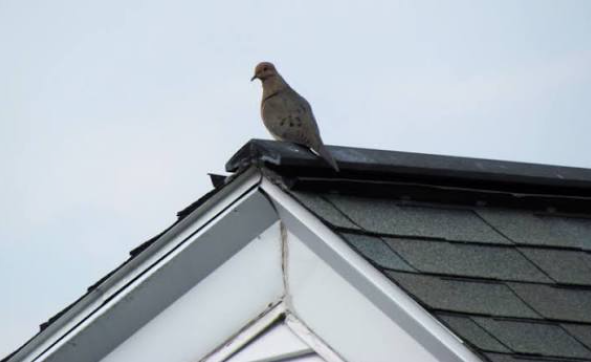
The same three ridge caps. The same $250 trip charge. The same line item on the invoice, four times in fourteen months. A homeowner calling roofers dayton tx that often for one twelve-foot run at the peak is usually not buying a repair at all, only renting one until the next squall comes through. The argument of this piece is simple: a ridge that fails on a schedule is an installation detail rather than storm luck, and rebuilding it correctly costs less than the fourth trip charge does.
The Ridge Is Not The Same As The Field
Field shingles sit in a lapped deck of overlapping courses, each one pinned by its neighbors above and below, which is why a ten-year-old subdivision roof can take a gust line without shedding a single tab. The ridge has none of that support. Caps sit alone along the peak, folded over an angle, exposed on two faces at once, and each one depends entirely on its own fasteners and its own seal.
So the wind picks the ridge and leaves the rest of the roof alone. Homeowners tend to read that pattern backwards. They look at an untouched field, decide the squall was mild and the caps were unlucky, and never ask why the only part of the assembly held together by one crew’s hand placement is also the only part that keeps landing in the flower bed.
See also: How Jewelry Becomes Part of Your Everyday Lifestyle
High Nailing And Missed Sealant Strips
Job after job, the same two things turn up when we pull the failed run apart. The first is what crews call high nailing, meaning the fastener went in above the marked nail zone, so it grabs only the cap it passes through and never bites the head of the cap below it. That single inch of misplacement halves the holding power of every nail on the peak.
The second is a sealant strip that never bonded. Cap shingles carry a factory adhesive bead that has to be warmed by sun and pressed flat to set. Install them on a cool morning, walk the ridge before the strip tacks, or bed them over a dusty cut edge, and you get a mechanical connection with no adhesive backup behind it. Both defects pass a ground-level look. Neither one shows up until the wind finds them.
Trip Charges Add Up Faster Than Materials
Materials at the peak are cheap. Labor to get a truck, a ladder and two people onto your street is not, and that is the number driving the whole problem. Run the arithmetic on a typical Dayton subdivision house and the repeat-repair habit stops looking like the thrifty option within a single storm season.
Say the ridge runs 42 linear feet and the house has lost three or four caps in each of four squalls, billed at a $250 trip charge every visit. That is $1,000 spent, of which maybe $60 was actual shingle. A full rebuild of the same 42 feet at roughly $14 per foot comes to $588, add a bundle of caps at $65 and a tube of compatible sealant at $12, and the whole detail comes to $665 done once. The four patch visits cost 50 percent more than the permanent fix and left the same twelve feet of peak in exactly the condition it started in. That gap is why homeowners eventually call roofers dayton tx for a rebuild quote instead of another patch.
What A Proper Ridge Rebuild Includes
Start by stripping the entire run, not the three caps that blew. A partial replacement leaves the surviving caps sitting on the same high nails that let their neighbors go, and those caps are next. Once the peak is bare, the sheathing gap and the ridge vent get inspected, because a vent screwed down through swollen or split decking will never hold a cap either, no matter how good the nailing above it is.
Then the fastening detail. Each cap takes fasteners set in the manufacturer’s nail zone, long enough to pass through the cap, the head of the cap below and the vent or the deck beneath, which on most ridge vent products means a 2 or 2.5 inch ring shank rather than the 1.25 inch coil nail sitting in the gun for the field. Nail length is the single most common shortcut on a ridge and the cheapest one to correct. Exposure gets held consistent, usually five to six inches, so no cap is left with a short lap that acts as a wind scoop.
The last piece is the seal. Caps go down in warm conditions where the adhesive can flatten and grab, and the two end caps at each gable get a hand-applied bead of compatible sealant because those are the ones the wind reaches first. Cut edges are seated clean. The hip and ridge product should match the field shingle line, not a bundle of three-tab cut into thirds, which is the old field fix that still shows up on subdivision roofs and still fails early. Done that way, the run is a system again rather than a row of loose parts, and it stops needing a technician on the calendar every quarter.
Storm Damage Or Installation Detail
There is a real test that separates the two, and it does not require a ladder. Storm damage is scattered: bruised field shingles, granule loss in the gutters, a bent vent cap, maybe fence pickets down on the same side of the yard. Installation failure is repetitive and local, the same short run of peak, in winds nowhere near design speed, while everything around it stays put.
Cost context is worth having before the estimate arrives. In a June 2026 roundup of asphalt maintenance pricing, the Journal of Light Construction put protective painting work on asphalt shingle surfaces at $5 to $12 per linear foot once rust removal and priming are included, which tells you how quickly per-foot roof work adds up on a long run. Weigh that against a repair you are buying repeatedly. Whether an insurer treats a repeat ridge failure as covered storm damage or as workmanship depends on the policy and on state rules, so put that question to your carrier rather than to a contractor.
Fix The Detail Once And Stop Paying Twice
Four identical invoices are not four separate weather events. They are one unfinished detail, billed over and over, and the honest read of that stack of paper is that nobody has yet been paid to fix the actual problem. Ask the next contractor to price the full run, name the nail length and the exposure in writing, and tell you what the seal plan is at the gable ends. If the answer is a handful of caps and another trip fee, the fifth squall has already been scheduled for you.