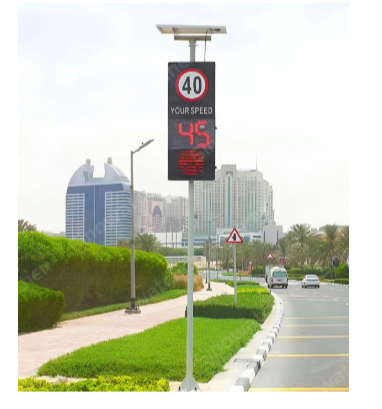
Every residential street has a story about speeding. A driver uses a quiet road as a shortcut to beat main-road traffic, a commuter cuts through above the limit, a delivery van races to its next stop. For the people who live there, these are not minor annoyances: speeding raises crash severity and makes crossings frightening for children and older residents.
One of the simplest and most effective answers is a radar speed sign. Mounted on a pole at the edge of the street, it measures each approaching vehicle’s speed with Doppler radar and shows it in bright LED digits. When drivers see their own speed flashing in front of them, most slow down without any enforcement, fine or confrontation.
Why Residential Streets Attract Speeding Drivers
Residential roads were designed for access, not through traffic, yet they often end up carrying both. When a main road congests, navigation apps and local knowledge send drivers down side streets never meant to take that volume or speed. Wide, straight streets make it worse: with open sightlines and few visual cues, drivers drift over the limit unnoticed.
- Cut-through routes linking two busier roads carry drivers with no reason to slow down.
- School runs and commuter peaks concentrate fast traffic into short morning and afternoon windows.
- Streets near parks mix fast vehicles with children who cross unpredictably.
How a Radar Speed Sign Changes Driver Behaviour
A radar speed sign, also known as a dynamic speed feedback sign, works by making speed visible. The unit uses 24 GHz Doppler radar to detect approaching vehicles at up to 100 metres, with 150-metre and 200-metre options, and shows the speed on a red and green LED speed display. Green means the driver is within the limit; red means they are over it. Face-feedback models add a smiling face under the limit and a warning face above it.
- Drivers see their own speed in real time, correcting the habit of drifting over the limit.
- The red display and warning face create a mild social nudge without any penalty.
- The sign works around the clock, including hours when enforcement is absent.
Choosing the Right Spots Near Homes, Schools and Parks
Placement decides whether a sign succeeds or goes unnoticed. The best position is on the approach to the problem, not in the middle of it: drivers need time to slow down before a crossing, a bend or a cluster of homes. Near a school, the sign should face traffic entering the school zone.
- Place the sign on the approach to the hazard, giving drivers time to react.
- Face it toward the traffic that causes the complaints, usually the cut-through direction.
- Keep the display clear of branches and parked vehicles that block the view
See also: The Gamification of Financial Literacy: How Esports Betting is Teaching a New Generation About Risk
Community-Led Traffic Calming: Getting Residents on Board
Traffic calming works best when residents help shape it. A community group that documents the problem, gathers signatures and presents a clear request to the local authority gets action far sooner than scattered individual complaints. A speed display sign is an easy ask: quicker to install than road humps, needing no roadworks, and it does not slow emergency vehicles.
- Keep a simple log of speeding incidents, with times, dates and direction of travel.
- Involve the local school or residents’ association to add weight to the request.
- Propose a trial period so the council can measure the result first.
Solar Power and Flexible Installation
Many residential streets have no mains connection where a sign is needed, and trenching a power cable is expensive and disruptive. A solar radar speed sign solves that problem: a solar panel of 60, 80 or 100 watts, depending on the model, charges a battery that keeps the sign running for 7 to 10 days through rainy weather. Its aluminium housing with outdoor powder coating suits year-round street use.
- Solar power avoids trenching, cabling and roadworks on a quiet street.
- Battery backup keeps the sign working through a week or more of cloudy weather.
- A portable radar speed sign can be moved between streets as problems shift.
Using Speed Data to Strengthen the Case
A driver feedback sign with speed data logging does more than slow traffic in the moment: it builds the evidence a neighbourhood needs for lasting change. Logged data can be exported to show the council when speeding happens and whether the sign is working, turning a complaint into a case.
- Recorded speeds show the worst times of day and the worst days of the week.
- Before-and-after data proves whether the sign has reduced speeds.
- Speed threshold configuration lets the sign match the local limit exactly.
Frequently Asked Questions
Do radar speed signs actually slow drivers down?
Yes. In a Federal Highway Administration demonstration project, dynamic speed feedback signs cut mean speeds by up to 10.9 mph, and most sites cut 85th-percentile speed by 3 mph or more. The Texas Transportation Institute recorded an 18 percent fall in school-zone average speeds, from 50 to 41 mph.
Where should a radar speed sign be placed in a residential area?
On the approach to the problem area, facing the traffic that causes the complaints, with a clear line of sight. Good spots include the entry to a school zone, the approach to a park, and the start of a cut-through street.
Do radar speed signs need a mains power supply?
No. Solar models run on a solar panel and battery, with enough charge to operate for 7 to 10 days through rainy weather. A mains option is available where a connection is convenient.
Can residents request a sign for their street?
In most areas, yes. A request is stronger when it comes from a group of residents with a written record of the problem. Proposing a trial period with logged speed data often helps the local authority say yes.
Final Thoughts
Residential streets should be places where children can play, neighbours can cross safely and people can live without the noise and risk of fast traffic. A radar speed sign will not solve every speeding problem on its own, but it is one of the fastest, simplest and least divisive ways to start.