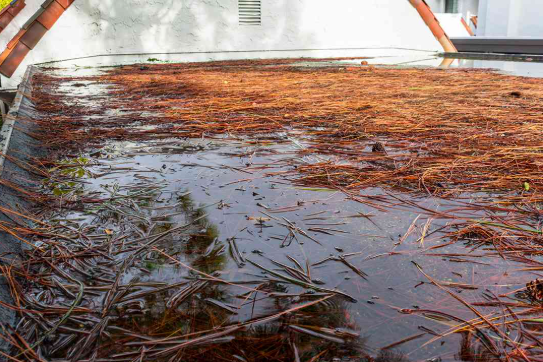
Flat roofs are not flat. The name is trade shorthand for a low slope, and every one of them is built to shed rain toward an outlet within a day or so of the storm that dropped it. So when the 1970s lanai addition on a Venice canal house still holds a pond three days after a summer downpour, the honest read is that something in the drainage system has failed, and roofing repair in venice fl at that point is a drainage and membrane job rather than a cosmetic one. Standing water is heavy. An inch of it across a modest lanai addition is more than a ton of load sitting on framing that was sized half a century ago, and the water collects at the low spot, deepens it, then gathers in the same place again after the next storm.
Ponding Signals Drainage Failure Not Design
Ponding has a working definition worth knowing: water still standing roughly 48 hours after the rain stopped. Below that, drainage is simply doing its job slowly. Above it, the roof has a problem it will not solve on its own. Think of a garden trampoline the morning after a storm, because the mechanism is identical: the fabric sags a little, water gathers in the sag, the added weight deepens the sag, and by breakfast there is a small pond nobody designed. A roof deck does the same thing at a slower speed and with worse consequences, since framing does not spring back the way a trampoline does. That is why another coat of patch compound over the wet spot is the wrong answer, and why the real fix is correcting the drainage path, rebuilding the failed seams, and replacing membrane that has already been stretched, in that order. Job after job, the same thing turns up on these older additions: the membrane across the open field is sound, and the failure is at an edge, a drain, or the tie-in nobody thought to look at.
See also: How Jewelry Becomes Part of Your Everyday Lifestyle
Check The Seams Where Two Materials Meet
The joint where a flat addition meets the wall of the older house is where most of these leaks begin. Two materials, two rates of expansion, one strip of flashing asked to absorb the difference for fifty summers. On TPO, EPDM, modified bitumen and PVC alike, the field membrane usually outlasts the detail at its edge. From the ground and from a second-story window, look for lifted edges, a chalky or crazed surface, fasteners that have backed out, and any place the membrane has pulled away from the counterflashing. (Yes, that means ten minutes of walking the perimeter with your head tipped back, which is nobody’s favorite Saturday.)
Watch The Ceiling Line Inside The Addition
The ceiling tells you what the roof will not. A dip along one seam, a hairline crack that keeps reopening after paint, a stain that grows a ring every August: those are load and moisture reaching the framing, not a decorating problem. Say this part plainly. If the ceiling is sagging, cracking or dripping, clear the space underneath it and call a professional rather than standing under it with a flashlight, because saturated decking and insulation come down as one heavy piece. Never walk out onto a flat roof that is holding water, and do not put a ladder up to look at a wet roof after a storm either. CDC and NIOSH researchers reported in MMWR that an estimated 81% of construction-worker fall injuries treated in US emergency departments involve a ladder, with work-related ladder falls causing 113 deaths in 2011. Those are people who climb for a living.
Note Which Storms Leave Water Behind
Keep a note on your phone. Date, roughly how long the rain lasted, and how many days the water sat afterward. Three entries across one summer tell a contractor more than a single walkthrough ever will, because the pattern is the diagnosis: if a twenty minute afternoon cell leaves water standing for three days, the drainage is undersized or blocked rather than overwhelmed. Wind belongs in the same notebook, and it helps to know how the insurance side reads a roof. In April 2026, Loveland Innovations published a roundup of Verisk insurance reports putting nearly 50% of all homeowners insurance claims in the wind and hail category, which makes roof damage one of the most common claim types in the country. That does not make a ponding problem a claim, and slow drainage on a fifty-year-old addition is usually maintenance. It does mean the storm dates you wrote down are worth having if an inspection later finds genuine wind damage sitting on top of the standing water.
Questions To Ask A Flat Roof Contractor
A flat roof specialist and a general roofer answer these differently, and the gap is clear inside a minute. Ask before anyone quotes a number, and write down what you hear. Someone who has actually rebuilt flat roof drainage reaches for specifics without being pushed for them.
- Where is the water supposed to go, and where is it actually going? A good answer names the drain, scupper or edge and explains why that outlet is not clearing.
- Is this a drainage correction, a seam repair, a membrane replacement, or all three? A good answer separates the three and prices them separately.
- Which membrane system is on there now, and which are you proposing? A good answer names TPO, EPDM, modified bitumen or PVC and says why that choice suits a lanai addition.
- How will you check the decking under the ponded area before you cover it? A good answer describes a test cut or a moisture scan, not a look at the surface.
- What does the warranty cover if water still stands after the work? A good answer gives a timeframe and states plainly what voids it.
Correct Drainage First Or Pay Twice
Every coating sold as a cure for ponding is formulated on the assumption that the water eventually leaves. Coat a roof that holds water for three days and you have bought a more expensive version of the same puddle, plus a surface the next contractor has to strip before doing the work properly. Sequence is most of the job: correct the slope and the outlet, then rebuild the seams, then re-cover. Anyone quoting roofing repair in venice fl on a flat lanai addition should walk you through that order without being asked, and should be willing to show you photos of the decking they found underneath. Fix the drainage and the pond stops forming. Skip it and you will be reading a checklist like this one again next August.