Something is happening in elementary classrooms across the United States. Children are falling further behind, not catching up.
In 2024, only 31% of fourth-grade students nationwide performed at or above the NAEP Proficient level in reading. Around 40% scored below the NAEP Basic level in reading, the largest percentage since 2002. These are not statistics about struggling schools in isolated communities. They are national averages. They describe the typical American elementary student.
For parents paying attention, these numbers are alarming. They raise a simple but urgent question: if the standard system is not building foundational skills and confidence in early readers, what is?
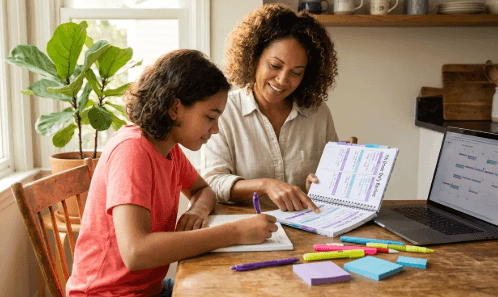
For a growing number of families, the answer is homeschool programs. Not because homeschooling is a radical act, but because a well-structured program at home can give elementary-age children something the average classroom cannot: learning designed specifically for them, at the pace that is right for them, in an environment where they feel safe to try, struggle, and succeed.
This blog looks at how structured homeschool programs build genuine academic confidence in young learners, and why that confidence, built early, changes the entire trajectory of a child’s education.
What Academic Confidence Actually Means in Early Education
Confidence in learning is not the same as liking school. It is the deep, internal belief that a child forms about themselves as a learner.
A child with genuine academic confidence believes that their effort leads to progress. They try something difficult without immediately shutting down. They ask questions instead of pretending to understand. They recover from mistakes rather than being defined by them. This belief does not emerge automatically. It is built through specific kinds of experiences, repeated over time.
In a traditional classroom, those experiences are limited by the group. A teacher managing 25 students cannot always slow down for the child who needs more time, or speed up for the child who is ready to go further. Over time, children who do not fit the class pace form a belief about themselves as learners. Some decide they are slow. Others decide learning is boring. Most accept a ceiling on their own potential that was never really theirs to own.
Structured homeschool programs create the conditions for a completely different kind of early educational experience, one where confidence is built deliberately rather than left to chance.
How Structure Itself Builds Confidence
This is where many parents misunderstand what structure means in a homeschool program. Structure is not rigid. It is not a recreated classroom with worksheets and timed tests.
Structure in a well-designed homeschool program means:
- A clear, sequential curriculum that ensures no foundational skills are missed
- Predictable daily rhythms that help children feel secure and settled
- Organized sessions that tell both parent and child exactly what comes next
- A visible record of what has been learned and how far the child has come
Each of these elements contributes to confidence in a specific way. When a child knows what to expect from the learning day, they spend less energy managing anxiety and more energy actually learning. When they can see their own progress documented over weeks and months, they build a concrete understanding of their own growth. When the curriculum is sequential and well-paced, mastery becomes the standard rather than the exception.
Children who experience mastery repeatedly become children who believe they can master new things. That is the core mechanism by which structured homeschool programs build confidence. Not by telling children they are smart, but by creating the conditions in which they consistently experience themselves as capable.
The Role of Pacing in Early Skill Development
In 2024, only 39% of fourth-grade students nationally performed at or above the NAEP Proficient level in mathematics, still 2 percentage points below the pre-pandemic rate in 2019. This gap has a root cause that the data points to clearly. When students move through material before they have mastered it, the gaps compound year after year.
Pacing is one of the most powerful variables in early education, and it is one that traditional classroom settings are structurally unable to manage well for every child. A homeschool program fixes this directly.
At home, a child who needs three weeks to fully grasp a mathematical concept gets three weeks. A child who absorbs it in one week moves forward without waiting. Neither child is penalized for their natural learning speed. Both experience mastery rather than approximation.
This matters enormously for confidence because mathematical and reading confidence in particular are built on a chain of dependent skills. A child who moves forward in reading before they have solid phonemic awareness develops a shaky foundation that makes every subsequent skill harder. A child who advances in mathematics before understanding place value will struggle with every operation that follows.
Homeschool programs that allow genuine pacing, not artificial pacing built around calendar dates and report card cycles, protect children from the accumulated self-doubt that comes from struggling on skills they were never quite ready for.
Connection and Safety as Foundations for Learning
One of the most underappreciated factors in early academic confidence is the emotional environment in which learning happens.
Young children learn best when they feel safe. That is not sentiment. It is neuroscience. When a child is anxious about being embarrassed, afraid of getting an answer wrong in front of peers, or stressed by a classroom environment that feels unpredictable, their nervous system is not in a state that supports deep learning. Stress hormones actively interfere with the cognitive functions needed for reading comprehension, mathematical reasoning, and retention.
The home environment, when it is warm and supportive, provides a level of psychological safety that most classrooms simply cannot replicate. A child who asks a question and gets a patient, encouraging answer from a parent who knows them deeply has a fundamentally different learning experience than one navigating the social complexity of a classroom of 25.
Structured homeschool programs leverage this natural advantage by giving parents the tools, the curriculum, and the confidence to be effective educators in that safe environment. The structure does not diminish the warmth. It gives it direction.
Character and Virtue as Part of Academic Confidence
Academic confidence does not exist in isolation. It is connected to a child’s broader sense of who they are and what they value.
Children who are learning in environments that explicitly build character, not just academic skills, develop a stronger foundation for confidence. Kindness, courtesy, perseverance, gratitude, and civic awareness are not soft add-ons to a rigorous curriculum. They are the qualities that determine how a child handles challenge, failure, setbacks, and success.
A child who has been taught to be curious sees difficulty as interesting rather than threatening. A child who has been taught to persist sees struggle as part of learning rather than evidence of inadequacy. A child who understands their place in a community and a world larger than themselves has a context for why learning matters that sustains motivation beyond grades and test scores.
The best structured homeschool programs integrate character education directly into the curriculum, not as a separate lesson but as the underlying philosophy that shapes how every subject is taught and experienced.
See also: Virtual Reality (VR) in Education and Training Platforms
Building Confidence That Lasts Beyond Elementary School
The years between Pre-K and the end of elementary school are the period in which a child’s identity as a learner is formed. What they decide about themselves during this window, whether they are the kind of person who can figure things out, who enjoys learning, who persists when things are hard, will shape how they approach every educational challenge for the rest of their lives.
Structured homeschool programs give parents the ability to shape that identity intentionally. Through consistent pacing, meaningful progress tracking, a safe learning environment, and a curriculum that builds both skills and character, they create the specific conditions in which early academic confidence is not just possible but likely.
Conclusion
The national data on elementary reading and mathematics performance is a clear signal that something in the current system is not working for a large share of young learners. The children leaving fourth grade without proficient reading skills are not failing to try. They are learning in a structure that was not designed with them specifically in mind.
Homeschool programs that are built on sound child development principles, structured carefully, and supported with professional educator resources give families a genuine alternative. One where early academic confidence is the goal, the standard, and the outcome.